Other
How to Read a Certificate of Analysis (COA)
A beginner's guide to understanding lab test results and what to look for in quality botanical products. Learn to read COAs like a pro.
On this page
What is a Certificate of Analysis?
A Certificate of Analysis (COA) is a document issued by an accredited laboratory that shows the results of tests performed on a product. For botanical products, a COA verifies purity, potency, and safety.
Think of a COA as a product's report card. It tells you exactly what's in the product and confirms it meets safety standards. Reputable vendors provide COAs for every batch they sell, and you should always review them before purchasing.
Key Sections of a COA
While COAs can vary in format between laboratories, most include these essential sections:
1. Laboratory Information
- Lab Name and Address: The testing facility's identifying information
- Accreditations: Look for ISO 17025 or similar certifications
- Contact Information: Legitimate labs provide ways to verify results
2. Sample Information
- Sample ID/Batch Number: Unique identifier for the tested batch
- Sample Description: What product was tested
- Date Received: When the lab received the sample
- Date Tested: When testing was performed
3. Test Results
This is the most important section. For botanical products, look for:
Potency Testing
Shows the concentration of active compounds, given as a percentage of the total extract. Look for the total active-compound content. Results should be expressed as percentages or mg/g.
4. Contaminant Testing
This section confirms the product is free from harmful substances:
- Heavy Metals: Lead, arsenic, mercury, cadmium (should all be below detection limits or within safe thresholds)
- Microbial Testing: Bacteria counts, E. coli, Salmonella (should show "Not Detected" or "Pass")
- Pesticides: Tests for common agricultural chemicals
- Mycotoxins: Tests for mold-produced toxins
Red Flags to Watch For
Be cautious if a COA is missing contaminant testing, shows results that exceed safe limits, lacks a batch number, or can't be verified with the laboratory directly. Also be wary of COAs that are clearly altered or have inconsistent formatting.
Understanding Test Results
Here's how to interpret common result formats:
Pass/Fail Results
Some tests (especially microbial) show simple pass/fail results. "Pass" or "Compliant" means the product meets safety standards. "Fail" or "Non-Compliant" means it doesn't - avoid these products.
Numerical Results
Many results show specific numbers with units:
- Parts per million (ppm) or ppb: Used for contaminants
- mg/g: Milligrams per gram, another way to express concentration
- CFU/g: Colony forming units per gram, used for microbial counts
Detection Limits
"ND" or "Not Detected" means the substance wasn't found at levels the test can measure. "< LOQ" means below the Limit of Quantification - present but too low to measure precisely. These results typically indicate a clean product.
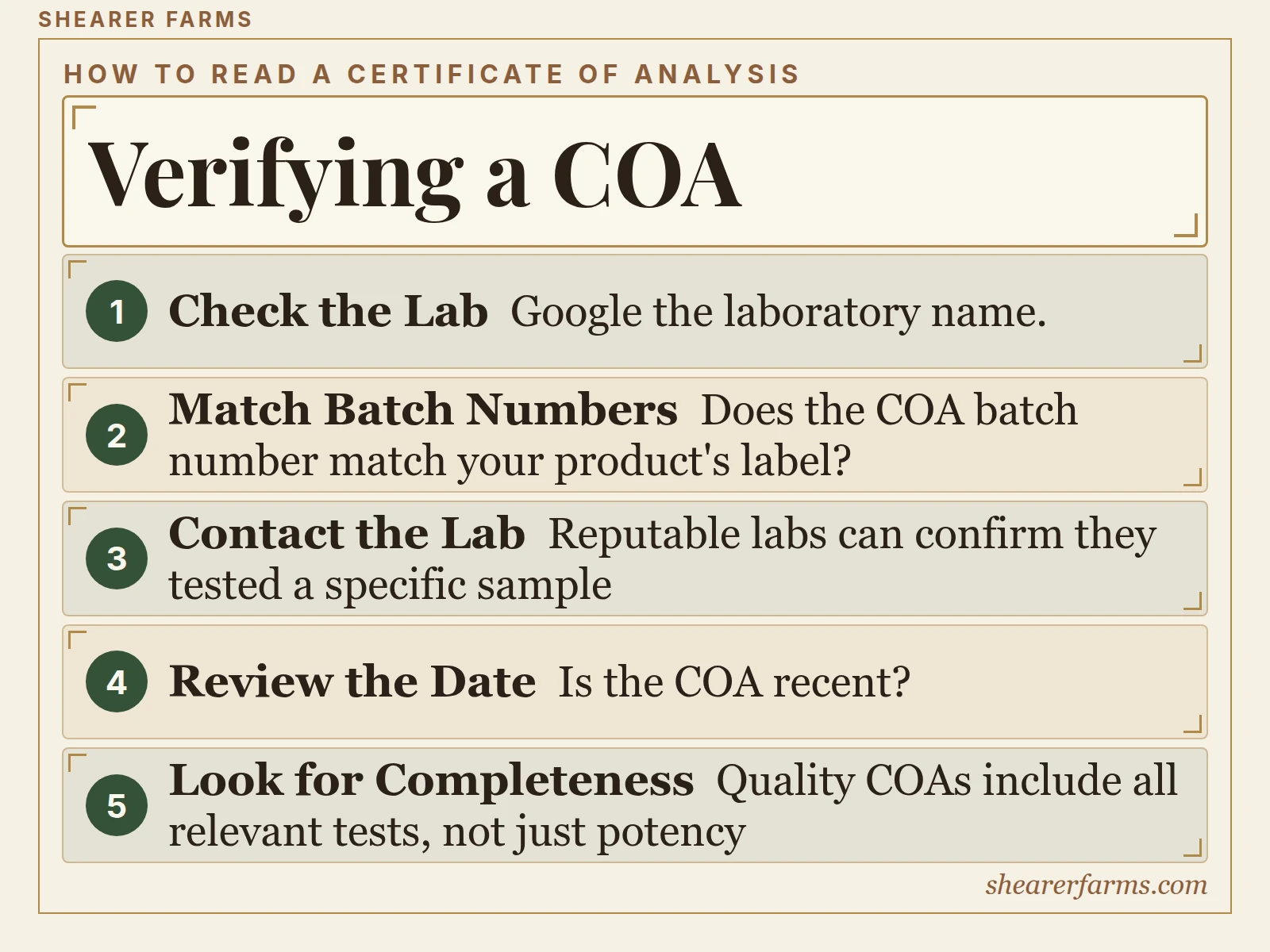
Verifying a COA
Don't just trust that a COA is legitimate. Here's how to verify:
- Check the Lab: Google the laboratory name. Is it a real, accredited testing facility?
- Match Batch Numbers: Does the COA batch number match your product's label?
- Contact the Lab: Reputable labs can confirm they tested a specific sample
- Review the Date: Is the COA recent? Testing should be from the current batch
- Look for Completeness: Quality COAs include all relevant tests, not just potency
COA Quick Checklist
- Lab is accredited (ISO 17025 or equivalent)
- Batch number matches product label
- Test date is recent (within 6-12 months)
- Potency testing is included
- Heavy metals testing shows safe levels
- Microbial testing shows "Pass" or "Not Detected"
- No signs of alteration or editing
- Lab contact information is verifiable
Why COAs Matter
Requesting and reviewing COAs protects you in several ways:
- Safety: Confirms products are free from harmful contaminants
- Accuracy: Verifies you're getting what's advertised
- Consistency: Helps you compare products and find reliable options
- Accountability: Vendors who provide COAs stand behind their products
What Each Test Actually Answers
A COA is a stack of separate questions, each answered by a different instrument. Knowing which instrument produced a number tells you what the number can and cannot prove. A clean heavy-metals line says nothing about potency, and a strong potency line says nothing about mold. The table lists the tests you will meet most often on a botanical COA, the method a lab usually uses for each, and the one question each result answers.
| Test | Method usually used | The question it answers | What it cannot tell you |
|---|---|---|---|
| Potency of named compounds | High-performance liquid chromatography (HPLC) | How much of each compound the lab looked for is in the sample | Whether compounds the lab did not look for are present |
| Heavy metals | Inductively coupled plasma mass spectrometry (ICP-MS) | How much lead, arsenic, cadmium and mercury is in the sample | Anything about organic contaminants |
| Residual solvents | Headspace gas chromatography (GC) | Whether solvent from extraction is still in the finished product | Whether the solvents tested are the ones that were actually used |
| Pesticide residues | Liquid or gas chromatography with mass spectrometry | Whether the listed agricultural chemicals are present above the reporting limit | Any pesticide that is not on the lab's list |
| Microbial counts | Plate counts and organism-specific tests | Whether total bacteria, yeast, mold, and named organisms were found in the portion tested | Whether every unit in the batch is the same as the portion tested |
| Mycotoxins | Liquid chromatography with mass spectrometry | Whether the toxins the lab listed are present | Whether the product is mold-free in general |
| Moisture or loss on drying | Oven drying or a moisture analyser | How much of the sample's weight was water | Anything about safety on its own |
Notice the right-hand column. Every test is limited to what the lab was asked to look for. A COA with six clean lines is a good start, and a COA with the right six lines for this kind of product is better.
Units: Reading the Numbers Without Guessing
Different sections of one COA often use different units, which is where most confusion starts. The conversions are plain arithmetic, so it is worth keeping them in front of you while you read.
| Unit as written | Says the same thing as | Where you see it |
|---|---|---|
| 1 percent (%) | 10 mg per gram, or 10,000 ppm | Potency |
| 1 mg/g | 0.1 percent, or 1,000 ppm | Potency |
| 1 ppm (parts per million) | 1 mg per kilogram, or 1 microgram per gram | Heavy metals, solvents, pesticides |
| 1 ppb (parts per billion) | 0.001 ppm, or 1 microgram per kilogram | Mycotoxins, some pesticides |
| CFU/g (colony-forming units per gram) | A count of living organisms that grew on a plate, per gram of sample | Microbial counts |
| ND or <LOQ | Not detected, or detected but below the level the lab can measure reliably | Every contaminant section |
Turning a potency percentage into milligrams
Suppose a COA reports a named compound at 4.2 percent in an extract. That is 42 mg of the compound in every gram of extract. If the label says a serving is 250 mg of extract, one serving holds 250 times 0.042, which is 10.5 mg of that compound. If you take two servings a day, the daily amount is 21 mg. Doing this once puts the COA and the label in the same unit, and it shows you at once when the two do not agree.
As received or dry weight?
Some COAs report results on an "as received" basis, meaning the sample as the lab got it, water included. Others report on a "dry weight" basis, with the water corrected out. A sample that holds 8 percent moisture and reports 4.2 percent of a compound as received would report about 4.6 percent on a dry basis (4.2 divided by 0.92). Neither is wrong. They are simply not comparable to each other, so check which basis each COA uses before comparing two products.
A Worked Example: Reading One COA Line by Line
The values below are invented to show the process; they are not from any real product. Read the table as if it were pasted from a lab report, and ask of each row what you would want to know before you were satisfied.
| Line on the report | Reported | What to check | Verdict in this example |
|---|---|---|---|
| Batch or lot number | L-2217 | Does it match the number printed on your bottle? | Yes, so this report belongs to this product |
| Date tested | Reported six weeks before the bottling date | Was the sample taken from the finished lot? | Ask the vendor; testing before bottling may be fine, but they should say so |
| Accreditation | ISO/IEC 17025 listed | Does the lab's scope cover these methods? | Look up the lab; accreditation is for specific tests, not the whole lab |
| Potency | 4.2 percent of the named compound | Does the label claim agree after the arithmetic above? | Label says 10 mg per serving; the report gives 10.5. Agrees |
| Lead | ND | What was the detection limit for the instrument? | Not enough information if the limit is missing |
| Residual solvents | Not tested | Was a solvent used to make the product? | If it was an ethanol extract, ask why this line is blank |
| Total yeast and mold | Under 100 CFU/g | What was the limit the lab compared it with? | Only meaningful if the report states the limit |
| Signature and date | Present | Can the lab confirm the report if asked? | Yes, if a contact or verification code is printed |
The example product comes out with two good lines and several open questions. That is a typical outcome. A COA is rarely a clean pass or a clear fail; it is a set of questions you can put to the seller, and how they answer is part of the evidence.
Red Flags and What They Usually Mean
| What you see | Why it matters | What to do |
|---|---|---|
| No batch number, or one that does not match your bottle | The report may describe a different product | Ask for the report that matches your lot |
| The seller's name is on the report but no lab is | The seller may have written it themselves | Ask for the original from the laboratory |
| Round or identical numbers across batches | Real measurements vary a little from batch to batch | Compare two reports side by side and ask about any that match exactly |
| Only potency is tested | Safety lines are missing | Ask whether contaminant tests were done and request them |
| Results shown as "Pass" with no numbers | You cannot see how close to the limit it was | Ask for the numeric values and the limits used |
| A report that is a screenshot with edited fonts or misaligned text | May have been altered | Ask the lab to confirm it directly |
| Report is more than a year old, or from before a recipe change | The current product may differ | Ask for a current report |
What a COA Cannot Do
Even a good COA has limits, and it helps to hold them in mind so the document is neither dismissed nor over-trusted.
- It describes a sample, not every bottle. The lab tests a small portion drawn from a batch. If a batch is not well mixed, the portion tested may not match every unit filled from it.
- It describes one moment. A report dated before bottling says nothing about what happened to the product afterward, including storage and heat.
- It covers only the list of tests. A contaminant that was not on the list is not on the report, and its absence from the report is not evidence it was absent from the product.
- It depends on the lab. Two labs can report different numbers for the same sample, especially for potency. Look at who did the testing and whether the methods are named.
- It is not a recommendation. A product can pass every line and still be wrong for you, your medications or your situation. See the guide on responsible dosing for how to start.
Questions to Ask the Seller
- Can I see the report for the lot number printed on this bottle?
- Which laboratory produced it, and may I contact them to confirm it?
- Were the contaminant tests run on the finished product or on the raw material?
- What limits were the results compared against, and where do they come from?
- How often do you test, and does every batch get its own report?
A seller who welcomes these questions and answers them plainly is telling you something. One who avoids them is telling you something as well.
Conclusion
Learning to read COAs is one of the most valuable skills for any botanical consumer. It takes just a few minutes to review a COA, but that small investment of time can protect your health and ensure you're getting quality products.
Always ask for COAs before purchasing botanical products. If a vendor can't or won't provide current lab testing, consider that a red flag and look elsewhere.
Our Transparency Promise
Pure Extracts provides comprehensive COAs for every batch of every product. We believe you deserve full transparency about what you're consuming. Our lab results are always available upon request and include complete potency and safety testing.
Common questions
What is a Certificate of Analysis?
A Certificate of Analysis (COA) is a document issued by an accredited laboratory that shows the results of tests performed on a product. For botanical products, a COA verifies purity, potency, and safety. Think of a COA as a product's report card. It tells you exactly what's in the product and confirms it meets safety standards. Reputable vendors provide COAs for every batch they sell, and you should always review them before purchasing.
What is key sections of a coa?
While COAs can vary in format between laboratories, most include these essential sections:. Lab Name and Address: The testing facility's identifying information. Accreditations: Look for ISO 17025 or similar certifications. Contact Information: Legitimate labs provide ways to verify results. Sample ID/Batch Number: Unique identifier for the tested batch.
How do I tell if how to read coa worked?
Here's how to interpret common result formats:. Some tests (especially microbial) show simple pass/fail results. "Pass" or "Compliant" means the product meets safety standards. "Fail" or "Non-Compliant" means it doesn't - avoid these products. Many results show specific numbers with units:.
What is verifying a coa?
Don't just trust that a COA is legitimate. Check the Lab: Google the laboratory name. Is it a real, accredited testing facility?. Match Batch Numbers: Does the COA batch number match your product's label?. Contact the Lab: Reputable labs can confirm they tested a specific sample.
Why do coas matter?
Requesting and reviewing COAs protects you in several ways:. Safety: Confirms products are free from harmful contaminants. Accuracy: Verifies you're getting what's advertised. Consistency: Helps you compare products and find reliable options. Accountability: Vendors who provide COAs stand behind their products.